


The ‘Cost Center’ Curse: How Continuous Improvement Teams Can Finally Break Free and Drive Real Business Value

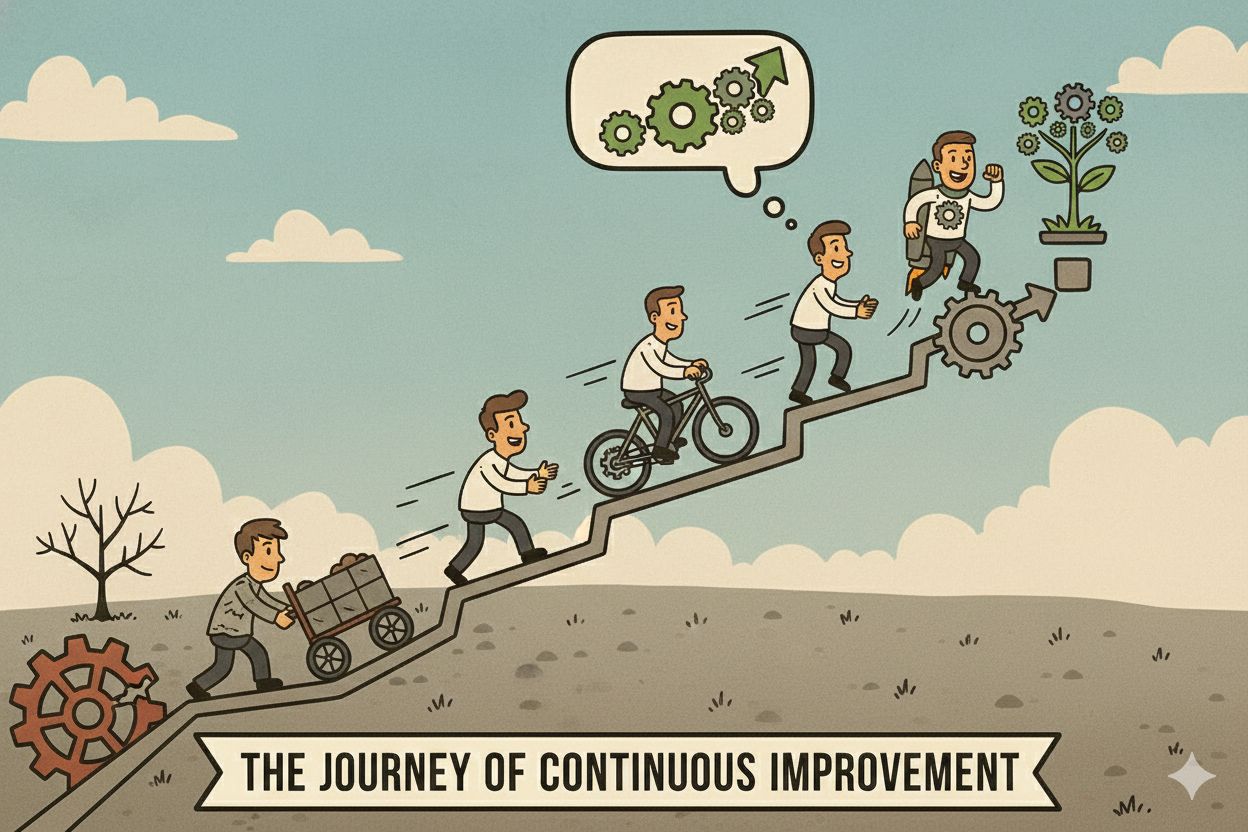
If you work in continuous improvement, you’ve probably lived this moment.
You walk into a steering committee meeting with a deck full of spotless process maps. Swimlanes are crisp. Handoffs are captured. Systems, roles, and variants are all in there. You have spent weeks interviewing SMEs, running workshops, and debating every edge case.
You finish presenting, feeling good.
Then someone in finance or operations leans back and asks the question that sucks the oxygen out of the room:
“This looks great. But what’s the ROI?”
Suddenly, all that effort is reframed as “nice documentation.” Your team is not seen as a growth engine. You are treated like overhead. A cost center.
That dynamic is not because continuous improvement is the wrong idea. It is because many teams are running the right discipline with the wrong operating model.
They optimize for activity, not outcomes.
They map everything, then struggle to point to anything that moved the needle.
They measure hours saved, then fail to translate those hours into business impact.
If that pattern sounds familiar, this article is for you.
The good news: you do not need a re-org or a new job title to change how your team is perceived. You need a repeatable flywheel that connects every improvement idea to strategy, execution, and measured value.
Business Compass was built around exactly that flywheel.
Across dozens of organizations, the same failure modes show up:
In that environment, continuous improvement is easy to cut when budgets tighten. Leaders see effort, not outcomes.
The shift you need is simple to describe and hard to execute:
Stop optimizing for how many things you touch. Start optimizing for how much value you can prove.
That is what the continuous improvement flywheel is designed to do.
Picture your program as a heavy flywheel. Getting it to move the first time is hard. Once it spins, every push gets easier and the momentum is obvious to everyone around it.
For CI teams, one full rotation of the flywheel looks like this:
Do that once, you get a single win and a little more trust.
Do it consistently, you stop being a cost center and become the team executives call when something important is broken.
Let’s walk through each step.
Most companies already have a “virtual suggestion box.” It lives in emails, chat threads, and drive folders. It is full of:
Your first job is not to collect more noise. It is to capture and structure the right kind of signal.
That means every idea should arrive as an opportunity, not a vague complaint:
“Upgrade the invoicing system” is a suggestion.
“Our invoicing process delays cash collection by seven days, tying up several million in working capital each quarter” is the beginning of a business case.
In Business Compass, those become Opportunities linked directly to processes and owners. You are not just logging “stuff to fix.” You are building an improvement pipeline that already points toward value.
This is where a lot of good work dies.
Teams have a backlog full of opportunities, but they cannot show how each one supports the company’s goals. When you cannot draw that line, your initiative looks optional.
There are four increasingly mature ways to create that line of sight:
Business Compass lets you visualize this alignment across process frameworks and capability maps so that when you walk into a meeting you do not say:
“We want to improve order entry.”
You say:
“We want to improve the Order-to-Cash capability that is on the CEO’s scorecard, and this opportunity is how we do it.”
That is the language of the C-suite.
Most organizations have more ideas than capacity. The selection mechanism is often:
That is how you end up working on visible projects, not valuable ones.
A simple scoring model changes the conversation. For each opportunity, score three dimensions:
Score everything, then visualize it.
In Business Compass, opportunities sit on a map of impact versus effort and alignment. You immediately see:
The team is no longer arguing about who shouts loudest. You are having an adult conversation about trade-offs, backed by data.
Once you pick a project, most teams rush straight into solution mode. That is where scope creep, missed dependencies, and disappointing outcomes come from.
The work you did earlier, mapping the actual process, is the antidote.
That becomes your implementation blueprint.
Simulation then turns that blueprint into a test bed. In Business Compass Simulation, you can:
You are not saying “we think this will be better.” You are showing how many hours, dollars, or cases per month are at stake if you implement the change.
That makes approvals much easier.
This is the moment that decides whether you stay a “cost center” or become a strategic partner.
If you do not establish a baseline and clear targets, you will only be able to say “we implemented the project.” That is not enough.
Instead, for every prioritized opportunity, define three things up front:
“Saving 300 hours” might sound good, but executives will still ask “So what?”
If you can instead say:
Now you are speaking in outcomes.
Business Compass helps by linking opportunities, processes, and result metrics so you can consistently tell that story: here is where we started, here is what we changed, here is what actually moved.
One full turn of the flywheel is not the finish line. It is the start.
If your wins stay trapped in slide decks, you miss the biggest lever you have to change your reputation: evidence.
Inside large enterprises, the most powerful questions are:
If another plant, line, country, or business unit cannot see what you did, they will reinvent the wheel or ignore the opportunity completely.
This is where you deliberately “market” continuous improvement:
One team’s solution becomes another team’s starting point.
In Business Compass, that repository is built-in: every opportunity, its linked processes, its prioritization, and its results live in one workspace. Sharing the dashboard in a town hall often does more to change perception than any slogan about “culture.”
When people across the organization start coming to you saying, “We saw what you did with X, can you help us with Y?”, you have broken the cost-center narrative.
Escaping the “cost center” label is not about working harder, mapping more, or branding your team differently.
It is about changing the system you run:
Do that, and three things start to happen:
Tools like Business Compass do not replace continuous improvement expertise. They give that expertise a structure, a memory, and a way to show its value at scale.
If you are tired of feeling like a cost center, the first step is not another mapping session. It is one full, deliberate turn of the flywheel.
Pick a single opportunity. Run it through all six steps.
Then make the results impossible to ignore.
Every day you wait is another day that six-figure savings stay hidden in your processes. Take the first step.


